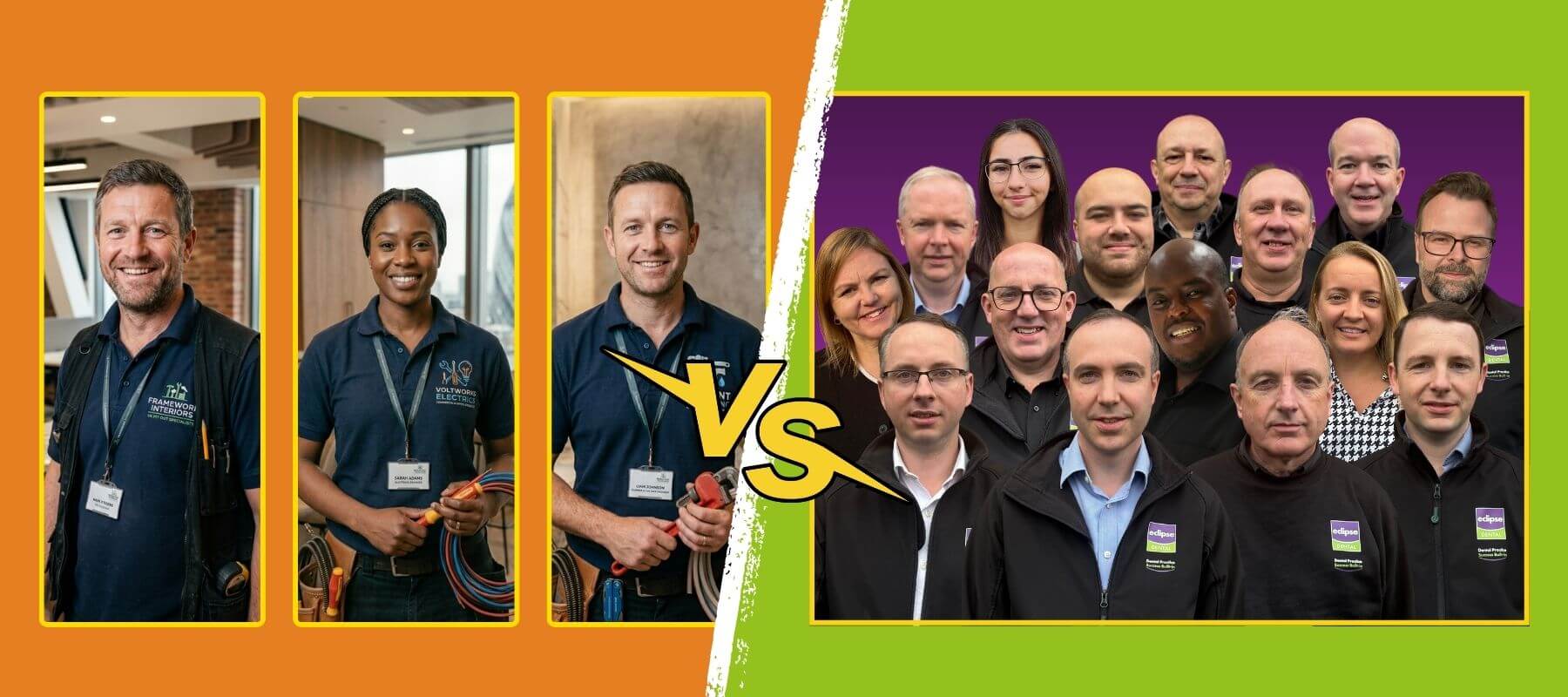
Most dental practice builds don’t fail because of big mistakes. They fail because of small decisions made early.
Choosing the wrong contractors.
Missing key infrastructure.
Underestimating how everything connects.
On paper, everything can look right. But once the practice is running, those decisions start to show.
In slower workflows.
In avoidable downtime.
In daily frustrations your team has to work around.
This is where most projects are won or lost.
If you get the right people involved early, the build runs smoother. Your layout works the way it should. Your equipment performs properly.
And your practice is set up for long-term success, not short-term fixes.
If you’re planning a new practice or a refurbishment, this guide will help you understand what to look for, where projects go wrong, and how to choose contractors who can deliver properly.
If you’re at the early stage, you can also download our “Step-by-Step Guide to Starting a Squat Dental Practice”, which breaks the full process down step by step.
Before any design work or construction starts, there are a few decisions that define how your project will run.
Most issues later in the build can be traced back to this stage.
Start with how you plan to work day to day.
These decisions affect everything that follows.
Layout, equipment, infrastructure and staffing all depend on this.
If this isn’t clear early, you end up redesigning later. That usually means delays and added cost.
It’s easy to focus on how the practice looks.
What matters more is how it works.
This is where experience matters.
A good design isn’t just compliant, it supports how your practice runs under pressure.
This is where many projects drift.
Build costs are only part of the picture.
You also need to account for:
What’s often missed are the hidden details.
Things like pipework runs, floor preparation or plant space don’t always show up in early quotes.
But they affect both cost and timeline.
Getting clarity early helps you avoid major adjustments later.

Every project has pressure points.
Approvals can take longer than expected. Site conditions can change once work starts. Equipment lead times can shift.
A realistic timeline accounts for this.
Break your project into clear stages:
If you get these decisions right early, everything else becomes easier.
If you don’t, issues tend to surface when your practice is already under pressure.
That’s when they’re hardest to fix.
Most problems in a dental build don’t come from one major mistake.
They come from gaps between people, different contractors working in isolation, no clear responsibility and decisions made too late.
Everything looks fine during the build.
Then the issues show up once the practice is running.
This is where projects break down.
Not because people didn’t do their job.
But because no one was responsible for how everything worked together.
Most of these aren’t obvious at the start.
You only notice them when your team is under pressure.
That’s why contractor choice matters more than most people expect.
When you start planning your build, you’ll usually end up choosing between three approaches.
They look similar on paper.
They don’t perform the same in practice.
| Option | Works for | Risks | When to choose |
|---|---|---|---|
| General builder | Basic refurb | Missed compliance, rework later | Very simple projects |
| Multiple suppliers | Lower upfront cost | Poor coordination, delays | Rarely worth it |
| Dental fit-out specialist | Full builds and refurbs | Higher upfront cost | Most projects |
A general builder can handle structural work.
But dental practices aren’t standard commercial spaces.
They involve:
Without that experience, key details get missed.
Those gaps usually show up later, when changes are harder and more expensive.
This is where you split the project:
On paper, this can look cost-effective. In reality, it creates risk.
No single point of responsibility means:
This is one of the most common causes of project drift.
A specialist approach brings everything together.
Design, build, equipment and compliance are planned as one system.
That changes how the project runs:
The upfront cost can be higher.
But the total cost is often more predictable, because fewer issues appear later.
This is why many practices that have tried to manage projects themselves don’t do it the same way twice.
Join dentists and practice managers using our resources to plan, build and run better practices.
You can unsubscribe at any time.
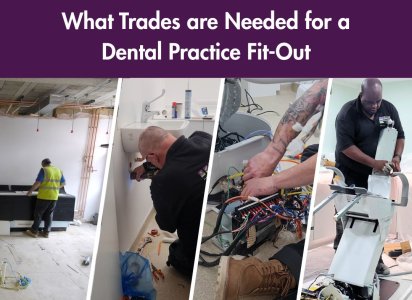
Every dental build involves the same core trades.
What matters is how well they work together.
Here’s what each role actually affects.
What they do:
Where problems happen:
The builder sets the foundation.
If this stage is wrong, everything that follows becomes harder.
What they do:
Where problems happen:
Dental equipment isn’t standard.
If electrics aren’t planned properly, performance and reliability suffer.
What they do:
Where problems happen:
A lot of issues only show up after installation.
At that point, fixing them is disruptive and costly.
What they do:
Where problems happen:
This role is often underestimated.
But it has a direct impact on how your practice performs day to day.
Each trade can do their job well. That doesn’t guarantee the project will work.
The real risk is in how these roles connect.
If no one is responsible for that overall picture, problems are almost inevitable.
That’s why the structure of your contractor setup matters just as much as who you choose.
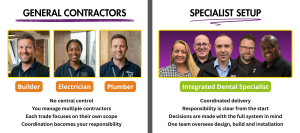
Who you hire shapes how the project runs and how your practice performs after.
At the start, both options can look similar.
Drawings. A quote. A timeline.
None of that shows what actually happens on site.
You see it when decisions need to be made. When trades need to coordinate. When something doesn’t go to plan.
And you feel it once you open.
In how your team works, in how your equipment performs and in how many issues you don’t have to deal with.
When something doesn’t line up:
This is where delays and compromises happen.
That changes the outcome:
You don’t notice the difference when things go to plan.
You notice it when something changes.
A layout adjustment. A service clash. A delay on site.
That’s where a coordinated approach saves time, cost and stress.
Most contractors will tell you they can deliver your project.
The question is how they deliver it.
Who is responsible for coordination?
If the answer isn’t clear, you will be managing it.
How is compliance handled?
Is it part of the design process, or checked at the end?
What experience do they have with dental projects?
General construction experience is not the same.
How are issues handled during the build?
Delays and changes will happen. What’s the process?
Can they show similar completed projects?
Not just images. Real examples of how the practice performs.
If everything sounds easy and straightforward, be cautious.
Most projects are neither.
Most dentists worry about losing control of the project.
Especially if this is your first build.
The risk isn’t handing over control, it’s having to take it back mid-project.
These shape how your practice performs long-term.
If you’re doing this, something is wrong with the structure.
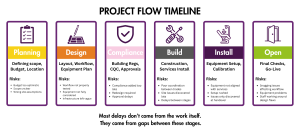
Most budgets don’t fail because of major errors.
We see them drift because of details that weren’t scoped early.
These aren’t always obvious at the start.
But they have a direct impact on cost and timeline.
Early quotes often focus on visible elements:
What’s missing are the details behind them. For example:
These aren’t optional. They just aren’t always included early.
Most of the important decisions in your project happen before any construction starts.
Once the build begins, your options become limited.
Changes take longer, costs increase and compromises start to creep in.
These aren’t finishing details.
They’re built into the design from the start.
Planning is often treated as a formality. Something to get through before the “real work” begins.
In reality, it’s the stage that defines everything that follows.
At that point, you’re working around decisions that should have been made earlier.
If you get the planning right, the build becomes straightforward.
If you don’t, the build becomes a series of adjustments.

A dental fit-out specialist doesn’t just deliver the build.
They shape how your practice works.
Instead of separate stages and suppliers, everything is aligned:
This reduces the gaps where problems usually occur.
This approach reflects how high-performing practices are built.
Design, build and equipment aren’t separate decisions.
They’re part of the same system.
The benefit doesn’t stop when you open.
This supports long-term performance, not just project completion.
That’s the difference between a space that looks right and one that works properly.
The success of your project isn’t defined during construction. It’s defined before it starts.
The contractors you choose, the decisions you make early and how well everything is planned together.
That’s what determines how your practice performs every day.
Most issues don’t come from major failures. They come from small details that weren’t considered early enough.
Those details affect:
If you get those decisions right from the start:
If you don’t, those issues tend to surface when you’re already open.
That’s when they’re hardest to fix.
If you want a second set of eyes on your plans, we can review them with you.
If you’re comparing quotes, we can help you understand what’s included, what’s assumed, and where risks might sit.
If you’re still early in the process, our 10-Step Guide for Starting a Squat Dental Practice breaks everything down step by step.
Trying to manage multiple contractors themselves without a clear structure. It often leads to delays, gaps in responsibility and decisions being made too late.
Because your contractors don’t just deliver the build. They define how your practice performs day to day. Poor coordination or missed details early on often lead to issues that only appear once the practice is operational.
It can look cheaper upfront. In practice, it often leads to delays, coordination issues and additional costs that weren’t accounted for early on.
Dental practices involve specialist equipment, clinical workflows and strict compliance requirements. These need to be considered together, not separately.
From the start. If compliance is left until later stages, it often leads to redesign, delays or compromises.
Clear planning, defined responsibilities and early coordination between trades are the biggest factors. Most delays come from gaps between stages, not the work itself.

Eclipse is an amazing company, always responding promptly when we require their assistance. They are providing yearly maintenance and repairs and we were never disappointed.

I had an excellent experience with Eclipse. Their expertise and attention to detail, and professionalism were outstanding from start to finish. The customer service is exceptional, always clear and efficient. I cannot recommend them enough.

Recently moved over to Eclipse from another company and i’m so glad we did. Their pricing is very competitive and they are very good with communication unlike the previous company we were using. We recently had our servicing completed and were very happy! Highly recommend this company!

We highly recommend Eclipse Dental to any dental practice looking for high quality equipment and reliable support. From supplying our dental chairs, CBCT scanner and autoclave to helping us set up our clinic within a very short time frame, it’s been a great experience working with them.

Always responsive, always helpful and have got us out of trouble in a matter of hours on many an occasion! Consistently good service and knowledgeable engineers at reasonable prices. Have already recommended to colleagues.

I have used them for the first time in recent months for a complicated project in carrying out a practice refurbishment. Eclipse were meticulous and brilliant. Very knowledgable engineers and a beautiful finish to my practice. They really are a family based business who will look after you. Very professional company and will definitely keep using them.

I had my 2 surgery practice completely stripped out and services repositioned with new flooring, new equipment and redecorated. They kept to the agreed time scale and we were up and running in our state-of-the-art new surgery. Thank you Eclipse and I will be using your services again.

I did a lot of research looking for a dental fit-out company before I came across Eclipse Dental. They designed the surgery exactly the way I wanted it to look which suits my requirements perfectly. The final result was phenomenal, just phenomenal!

The engineers that attend our practice are very knowledgeable and always act in a professional manner. If we have an emergency situation John Boyt always tries his best to fit us in. I have no hesitation in recommending Eclipse Dental Engineering to you for all your servicing and breakdown needs.
Eclipse listened to my ideas, they added a lot to them and improved my initial design. They had loads of realistic and creative ideas for a 21st century dental practice! Two surgeries were refurbished on time without any interruption of our clinics.

We would highly recommend the awesome Eclipse team who guided us through the design process, finishing touches and colour schemes. Their ability to combine build works with equipment and dental engineering makes it so much easier and better value.

I am very pleased with the result, it is of a high quality and surpassed my expectations, on the strength of the work done I commissioned some extra wall cabinetry. The whole process was hassle-free and I would be very happy to recommend Eclipse to my friends in the business.
We used Eclipse recently in an emergency as we had equipment failure. They were very quick to respond to our call and were able to get us working again within 2 hours. The engineer was very friendly and professional and I would highly recommend this company.

I would like to express my gratitude to you and your team for your professionalism and prompt response when our dental chair packed up. You attended the same day, removed the damaged chair and installed a rental to allow us to continue practising.
Having dealt with many fit-out companies over the years, Eclipse Dental has been one of the most professional, dependable and sincere companies I have ever worked with. I would not hesitate to use their services again.

Excellent service, Eclipse have worked tirelessly for us and have always come out same day if we have a problem stopping us working. Thanks to all at Eclipse.

Their awareness of CQC regulations regarding equipment relocation and our necessity to minimise downtime was brilliant. We would like to recommend Eclipse Dental to anyone considering a refurbishment or relocation.

Very happy with the service and reliability of the team. From the beginning to the end, everyone was always helpful and very kind. I definitely will recommend Eclipse Dental!

I liked how swiftly the projects were done. Everything was managed, everything was timed and everything was coordinated. And every day we saw something happening. It was very exciting.

The quality of craftsmanship was exceptional—the cabinetry, flooring and all custom elements were made precisely to our specifications and aligned perfectly with our vision for the space.

Brilliant. Just professional! Complete refit of surgery. Flawless.

The boys did well! We didn’t give them much time to prepare but they did a great job, extremely pleased.

We have had the chairs for some time now and are happy with them. They serve what we need them for. The aftercare service is excellent

Eclipse are very flexible and listen to your needs. We are very impressed with the quality of workmanship they delivered. I would not hesitate to continue recommending Eclipse.
Eclipse were always accommodating of any requests and would always go the extra mile. I look forward to working with them for many years to come.

We are delighted with the end result. The practice looks good and, more importantly, works ergonomically and efficiently.