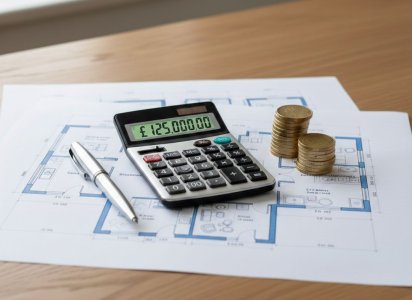
One of the first questions most dentists ask is: how much does it cost to set up a dental practice?
The honest answer is that there isn’t a single figure that applies to every project.
Two practices of a similar size can require very different levels of capital, depending on how the space is used, how the practice needs to operate and what already exists behind the walls.
Early estimates often fall down because they rely on assumptions that only hold true in ideal conditions.
This guide explains what actually drives costs in UK dental practice projects, why headline figures can be misleading and how to plan your budget with fewer surprises later on.
Dental practice costs vary widely because they are shaped by more than just square metres and finishes.
At a high level, your total capital requirement is made up of two parts:
This page focuses on the first part, where most budget overruns occur.
Cost-per-square-metre figures are often used as a starting point, but they can hide important detail.
A practice with fewer, lightly equipped surgeries may cost less than a smaller space that includes multiple surgeries, imaging, decontamination and central plant.
The clinical intensity of the space matters just as much as its size.
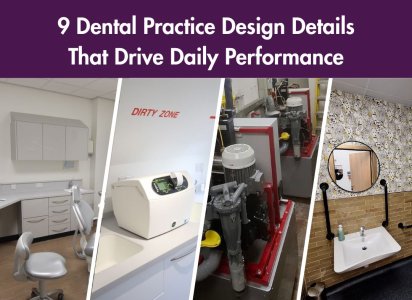
Compressors, suction units, autoclaves and water treatment systems are rarely visible on a floor plan, yet they play a major role in cost and layout.
Plant rooms, service runs and access for maintenance all need to be considered early. Retrofitting these later is one of the most common causes of budget creep.
Understanding these drivers is the difference between a budget that holds up under scrutiny and one that only works on paper.
Whether you refurbish an existing practice or start from a shell affects how cost and risk behave.
Neither route is automatically cheaper or more expensive. The difference lies in predictability, not headline budget.
Some refurbishments are light-touch projects. New flooring, décor updates or targeted room upgrades can be straightforward and cost-effective. Others involve deeper changes that introduce more uncertainty. New builds and squat practices usually cost more overall, but tend to behave more consistently once decisions are locked in.
Understanding where complexity comes from helps you set realistic budgets and contingencies from the outset.
Refurbishment covers a wide spectrum.
At one end, you may only be updating finishes, flooring or cabinetry. These projects can be tightly controlled with minimal risk if the underlying services are sound.
Complexity increases when scope extends beyond visible finishes, especially if the practice must remain operational.
Live practices introduce additional constraints:
These factors add time and cost that are not obvious from drawings alone.
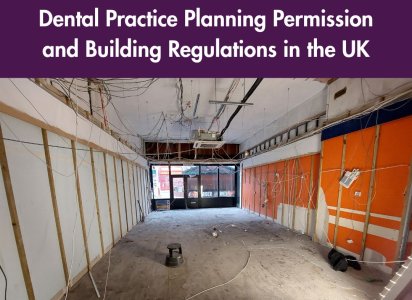
Even when a practice closes for works, refurbishment can still carry hidden risk. Existing buildings may conceal:
Until finishes are removed, these issues are not fully visible. This is why contingency is more important on refurbishment projects that go beyond surface-level upgrades.
A new build or shell unit offers a clean starting point.
Services can be designed from first principles, layouts can be optimised for workflow and compliance is built in rather than worked around. This often leads to a more efficient long-term outcome.
Squat practices require earlier decisions:
There are typically fewer unknowns behind the walls, but also less flexibility to change direction later without cost implications.
At this stage, it is important to stress that there are no standard prices for dental practice projects.
What can be shared are typical ranges, based on patterns seen across similar projects. These ranges overlap because real-world factors often push projects in different directions.
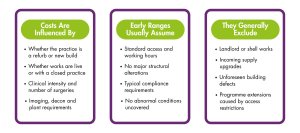
The purpose of sharing ranges is not to provide certainty, but to help you sense-check whether your expectations align with the reality of dental fit-out projects.
The estimator below is designed to help you sense-check your budget, not define it.
It uses high-level inputs such as overall size and specification to generate a broad budget range based on typical UK dental practice projects. The range you see does not account for site-specific factors such as hidden services, access limitations or structural alterations.
If the range broadly aligns with your expectations, the next step is to move beyond estimation and look at your project in context, using plans, photos and a brief to develop a more meaningful budget.
This estimate is a high-level guide based on typical dental practice projects.
It is not a quote and does not reflect site-specific conditions, existing services or building constraints.
The figures are intended for early planning only. A tailored budget requires a review of plans, photos and project requirements.
Early estimates are built on assumptions. As soon as a project moves into planning, those assumptions are tested against the reality of the building and how the practice needs to operate.
Common reasons budgets shift include:
None of this means an early estimate was wrong. It means it was doing its job, providing direction rather than certainty.
The next step is not a quote. It is a project brief, used to identify risks, clarify scope and determine what level of investment the building is likely to require.
If you would like a more informed view of your project, you can submit a short project brief below.
This allows us to review your requirements in context and provide guidance that reflects how the practice will actually be delivered, rather than how it appears on paper.
You do not need final plans to start this process. Approximate layouts, photos and notes are often enough to identify key cost drivers early.
Explore how we have supported dental practices with their build projects from coordination to full turn-key fit-outs.
There is no single figure, as costs depend on size, clinical scope and specification.
As a broad guide, setting up a squat dental practice typically requires a higher upfront investment than a light refurbishment, but it often involves fewer unknowns. New services can be designed from first principles, layouts can be optimised for workflow and compliance is built in rather than worked around.
Early budgets usually include building works, clinical fit-out and core infrastructure, but exclude property purchase, professional fees and working capital.
Refurbishment can appear cheaper initially, but this is not always the case.
Live refurbishments often involve phased works, out-of-hours working and unknown conditions behind existing finishes. These factors can increase time, complexity and contingency.
New builds and squat practices offer a cleaner starting point, but require earlier commitment to design decisions and approvals. In many cases, the overall investment between the two routes can overlap once risk and programme are taken into account.
Commonly overlooked costs include:
These costs tend to surface once surveys and strip-out begin, which is why early estimates should always be treated as indicative.
Online calculators are useful for early planning and sense-checking expectations.
They can indicate whether a project is likely to fall within a certain range, but they cannot account for site-specific factors such as existing services, access constraints or structural conditions.
For dental practices, accurate budgets are developed through site review, layout analysis and an understanding of how the practice needs to operate during and after the works.

I have used them for the first time in recent months for a complicated project in carrying out a practice refurbishment. Eclipse were meticulous and brilliant. Very knowledgable engineers and a beautiful finish to my practice. They really are a family based business who will look after you. Very professional company and will definitely keep using them.

I had my 2 surgery practice completely stripped out and services repositioned with new flooring, new equipment and redecorated. They kept to the agreed time scale and we were up and running in our state-of-the-art new surgery. Thank you Eclipse and I will be using your services again.

I did a lot of research looking for a dental fit-out company before I came across Eclipse Dental. They designed the surgery exactly the way I wanted it to look which suits my requirements perfectly. The final result was phenomenal, just phenomenal!

The engineers that attend our practice are very knowledgeable and always act in a professional manner. If we have an emergency situation John Boyt always tries his best to fit us in. I have no hesitation in recommending Eclipse Dental Engineering to you for all your servicing and breakdown needs.
Eclipse listened to my ideas, they added a lot to them and improved my initial design. They had loads of realistic and creative ideas for a 21st century dental practice! Two surgeries were refurbished on time without any interruption of our clinics.

We would highly recommend the awesome Eclipse team who guided us through the design process, finishing touches and colour schemes. Their ability to combine build works with equipment and dental engineering makes it so much easier and better value.

I am very pleased with the result, it is of a high quality and surpassed my expectations, on the strength of the work done I commissioned some extra wall cabinetry. The whole process was hassle-free and I would be very happy to recommend Eclipse to my friends in the business.
We used Eclipse recently in an emergency as we had equipment failure. They were very quick to respond to our call and were able to get us working again within 2 hours. The engineer was very friendly and professional and I would highly recommend this company.

I would like to express my gratitude to you and your team for your professionalism and prompt response when our dental chair packed up. You attended the same day, removed the damaged chair and installed a rental to allow us to continue practising.

Having dealt with many fit-out companies over the years, Eclipse Dental has been one of the most professional, dependable and sincere companies I have ever worked with. I would not hesitate to use their services again.

Excellent service, Eclipse have worked tirelessly for us and have always come out same day if we have a problem stopping us working. Thanks to all at Eclipse.

Their awareness of CQC regulations regarding equipment relocation and our necessity to minimise downtime was brilliant. We would like to recommend Eclipse Dental to anyone considering a refurbishment or relocation.

Very happy with the service and reliability of the team. From the beginning to the end, everyone was always helpful and very kind. I definitely will recommend Eclipse Dental!

I liked how swiftly the projects were done. Everything was managed, everything was timed and everything was coordinated. And every day we saw something happening. It was very exciting.

The quality of craftsmanship was exceptional—the cabinetry, flooring and all custom elements were made precisely to our specifications and aligned perfectly with our vision for the space.

Brilliant. Just professional! Complete refit of surgery. Flawless.

The boys did well! We didn’t give them much time to prepare but they did a great job, extremely pleased.

We have had the chairs for some time now and are happy with them. They serve what we need them for. The aftercare service is excellent

Eclipse are very flexible and listen to your needs. We are very impressed with the quality of workmanship they delivered. I would not hesitate to continue recommending Eclipse.
Eclipse were always accommodating of any requests and would always go the extra mile. I look forward to working with them for many years to come.

We are delighted with the end result. The practice looks good and, more importantly, works ergonomically and efficiently.