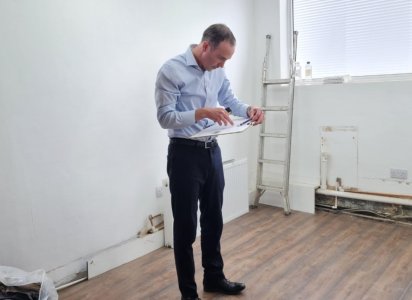
Before you sign a lease, submit drawings or order equipment, you need one clear answer:
Can this building operate as a compliant, fully functioning dental practice?
Planning permission and building regulations are not administrative steps to deal with later. They determine:
When these questions are addressed too late, projects stall. We regularly see:
Since September 2020, dental practices fall within Class E of the Use Classes system. That can simplify change of use in some commercial properties.
It does not remove planning risk.
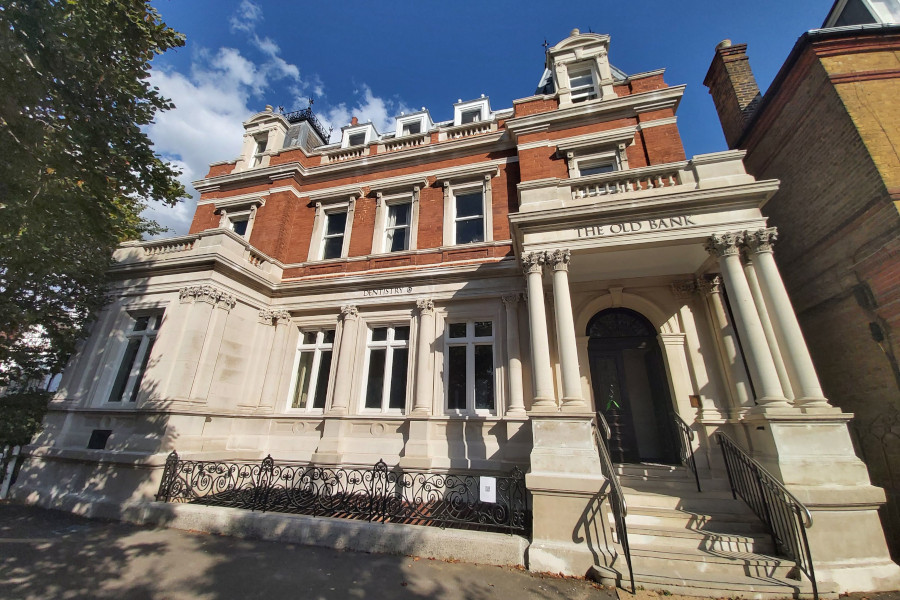
External alterations, listed buildings, conservation areas, residential conversions and Article 4 directions can still trigger formal applications.
These factors should be confirmed before contracts are signed.
As an engineering-first business, we assess viability through a technical lens from day one. That means reviewing services capacity, ventilation strategy, radiation protection requirements, compliance routes and future expansion potential before design is finalised.
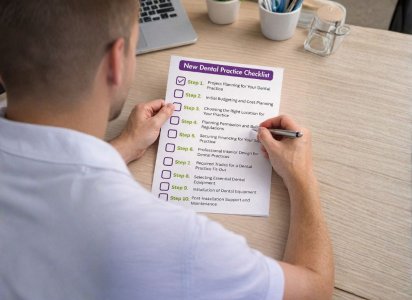
If you are planning a squat practice, this early-stage clarity becomes even more critical. For a structured walkthrough of the full journey, from site selection to opening day, our free “10-Step Guide for Starting a Squat Dental Practice” breaks down the commercial, regulatory and operational decisions that shape a successful launch.
It is designed to help you avoid costly missteps and plan your project with confidence.
In the sections below, you’ll see:
Planning permission controls how land and buildings are used and how they affect their surroundings.
For dental projects, the key question is usually change of use.
If a property already operates within Class E (Commercial, Business and Service), it may be possible to change use to a dental practice without a full application.
However, planning consent may still be required where:
Assuming flexibility without checking can lead to refusal after financial commitment.
Planning focuses on impact: noise, traffic, appearance and neighbour effect.
Building regulations focus on safety and performance. They are separate approvals.
Confusion between these two approvals is a common source of delay.
They are different processes with different purposes.
| Planning Permission | Building Regulations | |
|---|---|---|
| What it controls | How the building is used and its impact on surroundings | How the building is constructed and performs |
| Focus | Use class, external appearance, noise, traffic, neighbour impact | Fire safety, structure, ventilation, drainage, accessibility, energy performance |
| Who approves it | Local Planning Authority | Building Control (Local Authority or Approved Inspector) |
| When it’s triggered | Change of use, external alterations, plant installation, residential conversion | Structural alterations, internal reconfiguration, new services, compliance upgrades |
| What happens if you ignore it | Refusal, enforcement action, project delay | Failed inspection, rework, inability to sign off works |
You can secure planning approval and still fail building regulations.
Equally, you can comply with building regulations but still require planning consent.
They are not interchangeable.
Launching a squat practice or converting a commercial unit carries more technical risk than refurbishing an existing surgery.
The most expensive mistake is committing to the property before confirming it can support clinical use.
If the property is already within Class E, change of use may be simpler. That does not confirm the building is suitable for dental services.
Before signing a lease, you should assess:
Retail and office units were not designed for clinical environments. Services and compliance demands are higher.

Residential conversion typically requires:
Structural alteration, fire upgrades and full service redesign are common.
Programme length and cost are usually greater than commercial-to-commercial conversion.

At minimum, confirm:
This early assessment reduces redesign, protects funding arrangements and keeps your programme realistic.
When a dental project budget increases, it is rarely because of finishes.
It is usually because of infrastructure.
Many cost changes stem from issues that are not visible during an initial viewing.
Retail and office units often have solid slabs.
Running suction and waste lines may require:
Across multiple surgeries, this becomes significant.
Dental practices carry heavier loads than most commercial spaces.
Compressors, suction systems, imaging equipment and decontamination rooms draw substantial power.
If the supply is insufficient, you may require:
These are not cosmetic costs. They are operational necessities.
Internal reconfiguration often triggers:
Fire compliance is structural, not optional.
If shielding requirements are not confirmed before ordering CBCT or OPG equipment, room dimensions or wall construction may need revision.
That is preventable with early assessment.
They are not unexpected.
They are simply not investigated early enough.
A technically assessed project identifies infrastructure constraints before contracts are signed.
That makes the budget more realistic from the outset.
Join dentists and practice managers using our resources to plan, build and run better practices.
You can unsubscribe at any time.
Building regulations are not an afterthought. They influence the layout from the beginning.
In dental environments, several Approved Documents have direct impact.
Affects:
Layout decisions and corridor widths often hinge on fire strategy.
Influences:
Ignoring accessibility early results in redesign later.
Clinical spaces require appropriate air changes.
Extraction routes must be feasible and compliant.
This interacts with both planning and building control requirements.
Refurbishment may trigger:
Older buildings often require additional work here.
Dental drainage requires correct gradients and amalgam separation.
If existing routes are unsuitable, structural alteration may be necessary.
Imaging installations require:
These requirements are set out within the Approved Documents issued under the Building Regulations.
In dental projects, services and compliance shape design.
If infrastructure is reviewed after layout approval:
Each change increases cost and uncertainty.
An engineering-led review considers:
These questions are resolved before design is finalised.
That reduces variation and protects delivery.
You are not simply fitting out a building.
You are creating a clinical environment that must perform reliably for years.
Dental projects become unpredictable when approvals overlap without order.
This sequence separates feasibility, compliance and delivery. Each phase ends with a clear decision gate before moving forward.

Planning permission and building regulations are not obstacles to work around.
They define whether your dental practice can operate safely, open on time and expand in the future.
When these issues are tested early, your project becomes predictable.
When they are assumed, risk increases.
Before committing to a lease or construction programme, you should be clear on:
That clarity protects your timeline, your funding and your long-term compliance.
If you are launching a squat practice, regulatory approval is only part of the equation. Commercial planning, services integration and operational flow all influence performance.
Our free “10-Step Guide for Starting a Squat Dental Practice” outlines the full pathway, from site selection to opening day. It provides a structured overview of the decisions that shape a successful launch.
If you are assessing a property or considering a conversion, arrange a planning and compliance review before committing financially.
Early certainty is always less expensive than late correction.
Explore dental practices delivered through careful planning, building regulation expertise and engineering-led design that supports long-term performance.
Possibly.
If the unit already falls within Class E, change of use may not require a full planning application. However, you may still need consent for:
Always confirm the local planning position before signing a lease.
No.
Class E allows flexibility within certain commercial uses, including dental practices. It does not override restrictions relating to residential conversion, external works or local Article 4 directions.
Assuming approval without checking is a common cause of delay.
You will need:
Shielding feasibility should be confirmed before ordering equipment.
You can, but it increases risk.
If planning is refused or services upgrades are more extensive than expected, you remain contractually committed.
Confirming planning position and technical viability before signing protects your timeline and budget.
Typically:
These are avoidable when viability is assessed early.
Before finalising layout or signing a lease.
Early technical review ensures the building can support compliant ventilation, drainage, power load and equipment integration.
That reduces redesign and protects programme certainty.
CQC expects premises to be safe, accessible and appropriately designed for clinical use.
Poor early decisions around layout, decontamination flow or accessibility can delay registration.
Regulatory alignment should be built into design from the outset.

I have used them for the first time in recent months for a complicated project in carrying out a practice refurbishment. Eclipse were meticulous and brilliant. Very knowledgable engineers and a beautiful finish to my practice. They really are a family based business who will look after you. Very professional company and will definitely keep using them.
I had my 2 surgery practice completely stripped out and services repositioned with new flooring, new equipment and redecorated. They kept to the agreed time scale and we were up and running in our state-of-the-art new surgery. Thank you Eclipse and I will be using your services again.

I did a lot of research looking for a dental fit-out company before I came across Eclipse Dental. They designed the surgery exactly the way I wanted it to look which suits my requirements perfectly. The final result was phenomenal, just phenomenal!
The engineers that attend our practice are very knowledgeable and always act in a professional manner. If we have an emergency situation John Boyt always tries his best to fit us in. I have no hesitation in recommending Eclipse Dental Engineering to you for all your servicing and breakdown needs.
Eclipse listened to my ideas, they added a lot to them and improved my initial design. They had loads of realistic and creative ideas for a 21st century dental practice! Two surgeries were refurbished on time without any interruption of our clinics.

We would highly recommend the awesome Eclipse team who guided us through the design process, finishing touches and colour schemes. Their ability to combine build works with equipment and dental engineering makes it so much easier and better value.

I am very pleased with the result, it is of a high quality and surpassed my expectations, on the strength of the work done I commissioned some extra wall cabinetry. The whole process was hassle-free and I would be very happy to recommend Eclipse to my friends in the business.
We used Eclipse recently in an emergency as we had equipment failure. They were very quick to respond to our call and were able to get us working again within 2 hours. The engineer was very friendly and professional and I would highly recommend this company.

I would like to express my gratitude to you and your team for your professionalism and prompt response when our dental chair packed up. You attended the same day, removed the damaged chair and installed a rental to allow us to continue practising.
Having dealt with many fit-out companies over the years, Eclipse Dental has been one of the most professional, dependable and sincere companies I have ever worked with. I would not hesitate to use their services again.
Excellent service, Eclipse have worked tirelessly for us and have always come out same day if we have a problem stopping us working. Thanks to all at Eclipse.
Their awareness of CQC regulations regarding equipment relocation and our necessity to minimise downtime was brilliant. We would like to recommend Eclipse Dental to anyone considering a refurbishment or relocation.
Very happy with the service and reliability of the team. From the beginning to the end, everyone was always helpful and very kind. I definitely will recommend Eclipse Dental!
I liked how swiftly the projects were done. Everything was managed, everything was timed and everything was coordinated. And every day we saw something happening. It was very exciting.

The quality of craftsmanship was exceptional—the cabinetry, flooring and all custom elements were made precisely to our specifications and aligned perfectly with our vision for the space.

Brilliant. Just professional! Complete refit of surgery. Flawless.

The boys did well! We didn’t give them much time to prepare but they did a great job, extremely pleased.
We have had the chairs for some time now and are happy with them. They serve what we need them for. The aftercare service is excellent

Eclipse are very flexible and listen to your needs. We are very impressed with the quality of workmanship they delivered. I would not hesitate to continue recommending Eclipse.
Eclipse were always accommodating of any requests and would always go the extra mile. I look forward to working with them for many years to come.

We are delighted with the end result. The practice looks good and, more importantly, works ergonomically and efficiently.