Most dental practice designs look right on paper. But they are not always ideal in reality.
What matters is how the space works day to day.
How your team moves between tasks.
How easily instruments flow through the practice.
How reliably your equipment performs under pressure.
When design decisions are made without this in mind, the problems do not show up immediately.
They show up during busy clinics, when time is tight and small inefficiencies start to slow everything down.
A well-designed practice is about building a system that supports how your practice operates.
This is where working with a team that understands both design and engineering makes a difference.
From early planning through to fit-out, equipment installation and ongoing support, every decision should be made with long-term performance in mind.
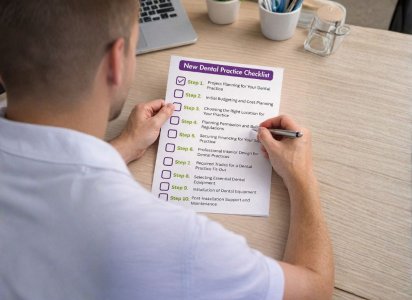
If you are planning a new practice, our 10-Step Guide for Starting a Squat Dental Practice gives you a clear structure to follow.
It covers the full journey, from early planning and funding through to final fit-out, helping you avoid common mistakes and make better decisions at each stage.
Good dental practice design is not about how your practice looks.
It is about how it performs.
At a practical level, your design should support four key areas:
Your team should be able to move naturally through the space without unnecessary steps or interruptions.
Small layout decisions affect everything.
From how quickly you can prepare a surgery for the next patient to how comfortable your team feels during a full day of treatment.
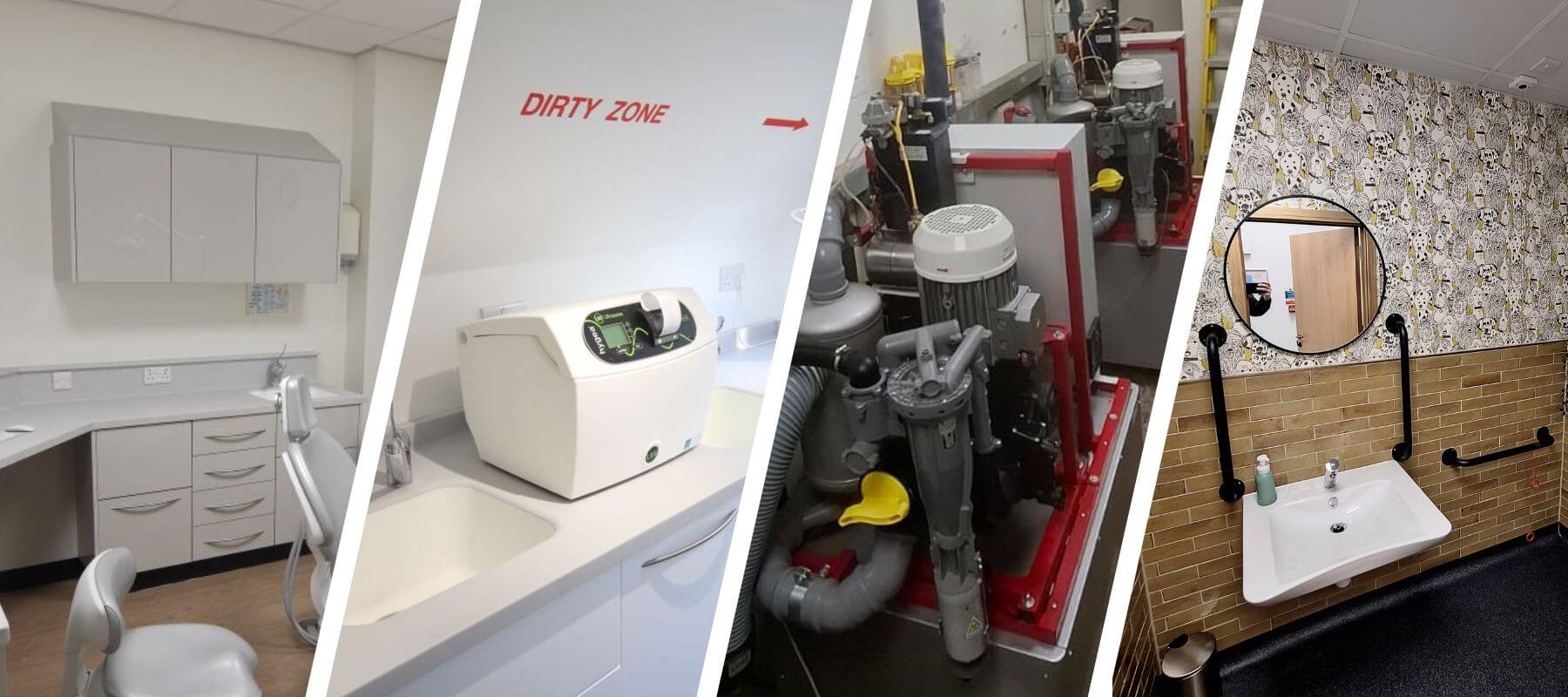
Infection control should not be added later.
It should shape the design from the start.
This includes materials, surfaces, zoning and how equipment is positioned within the space.
When this is done properly, cleaning becomes simpler and more consistent.
Your practice relies on equipment, services and infrastructure working consistently.
That means planning for:
These are often overlooked early, but they directly affect downtime later.
Your practice will change over time.
Technology will evolve.
Patient demand will shift.
Your services may expand.
Your design should allow for that.
This includes capacity in your electrics, data infrastructure, suction and air systems, as well as space to adapt layouts without starting again.
Most design issues come from decisions made too early, without fully understanding how the practice will operate once it is live.
Get these fundamentals right, and everything else becomes easier.
| Area | Poor Design Outcome | Well-Planned Design Outcome |
|---|---|---|
| Workflow | Slow turnaround, staff fatigue | Efficient movement, faster turnaround |
| Infection Control | Inconsistent cleaning | Built-in hygiene and easy maintenance |
| Infrastructure | Breakdowns and limitations | Reliable daily operation |
| Flexibility | Expensive upgrades later | Easy to adapt and expand |
| Compliance | Risk of redesigns | Built-in from the start |
Join dentists and practice managers using our resources to plan, build and run better practices.
You can unsubscribe at any time.
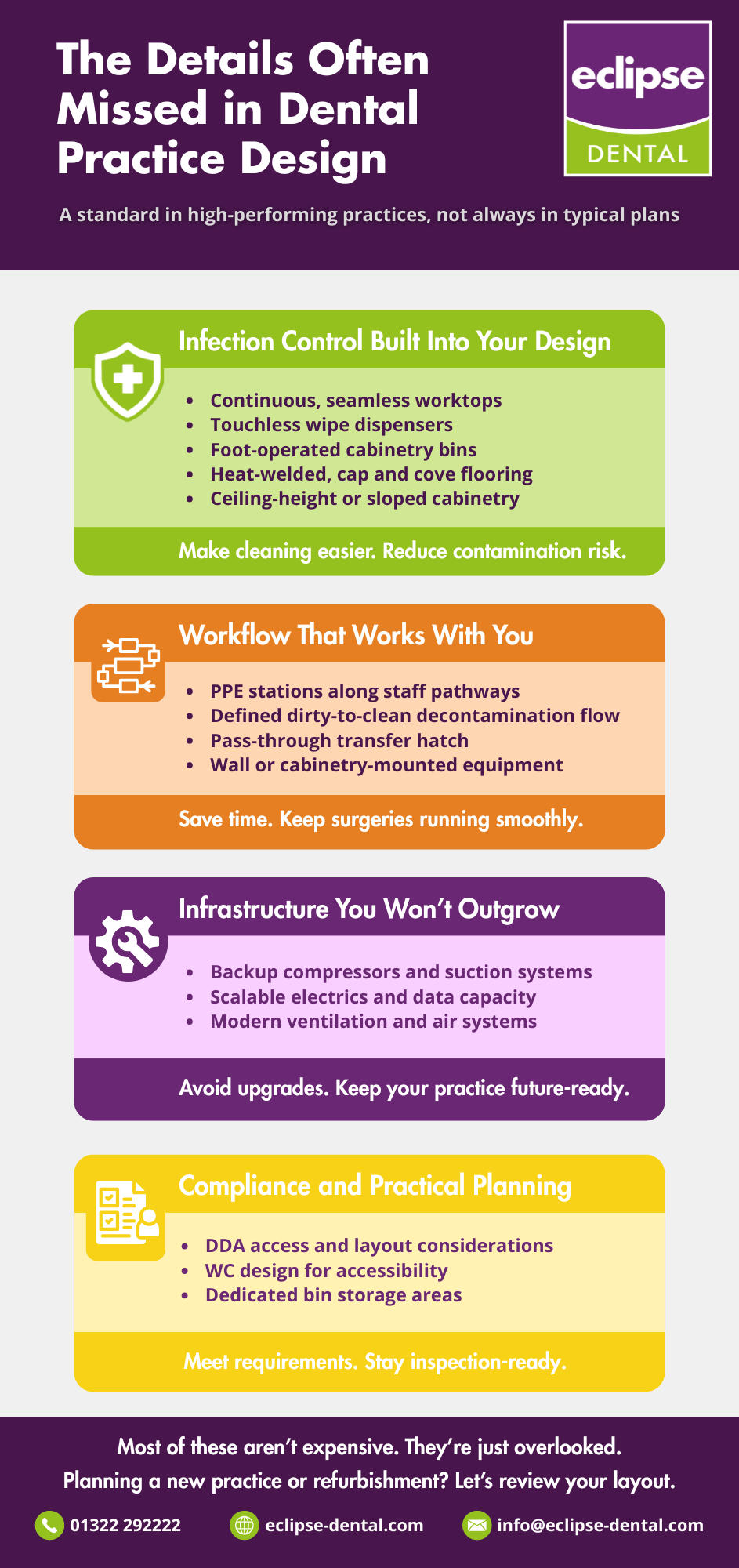
These are the decisions that rarely show on drawings.
But they define how your practice performs every day.
They affect how easily you can clean, how your team works and how well your practice holds up over time.
What this changes:
Cleaning becomes faster, more consistent and less dependent on individual habits.
What this changes:
Reduces bottlenecks and lowers the risk of cross-contamination during busy periods.
What this changes:
Fewer touchpoints and less clutter, making the surgery easier to clean and maintain.
What this changes:
Removes areas that are difficult to clean and often missed.
What this changes:
Reduces downtime risk and avoids reactive fixes that disrupt your day.
What this changes:
Improves comfort, supports compliance and helps maintain consistent clinical conditions.
What this changes:
Avoids redesigns and ensures your practice is usable for all patients.
What this changes:
Gives you flexibility to grow without major disruption later.
What this changes:
Supports day-to-day operation and keeps the practice compliant behind the scenes.
Most of these decisions are small in isolation.
Together, they define how your practice runs.
Get them right early, and everything else becomes easier.
Real projects showing how smart design improves efficiency, reduces issues and supports long-term performance.
Most design issues are not obvious at the start.
They appear once the practice is busy and under pressure.
The same mistakes come up repeatedly:
Layouts are often driven by how the space looks, not how it functions.
This leads to:
Key systems are often treated as secondary:
These are harder and more expensive to fix later.
Compressors and suction units are squeezed into available space rather than planned properly.
This creates:
Decontamination is sometimes fitted around the layout rather than designed properly.
This leads to:
Designs are often based on current needs only.
But practices evolve.
Without planning for expansion, you risk:
Most of these issues come from early decisions made without a full understanding of how the practice will operate.
They do not fail immediately.
They fail over time.
Common design failures you only notice later:
A well-designed dental practice should feel easy to work in.
Your team moves without friction. Your equipment performs reliably. Your workflows support you, not slow you down.
That only happens when the right decisions are made early.
When design, engineering and long-term operation are considered together, the result is a practice that works properly from day one.
Get the details right at the start, and you avoid the problems most practices only discover later.
Function comes first.
Your design needs to support how your practice operates day to day. That includes workflow, infection control, equipment performance and how easy the space is to maintain. If these are right, everything else becomes easier to manage.
As early as possible.
Many of the biggest issues come from decisions made too late. Infrastructure, layout and compliance requirements should be considered before you commit to a site or final drawings. Early planning gives you more control and avoids unnecessary compromises.
The small operational details are often missed.
Plant space, cleaning access, decontamination flow and future capacity are not always obvious in early designs. These details have a direct impact on how the practice runs once it is in use.
You need to plan beyond your current needs.
Your practice will change over time as technology evolves and demand grows. Building in additional capacity for systems such as air, suction, electrics and data allows you to adapt without major disruption later.
Downtime is managed through planning and sequencing.
Phased works, out-of-hours installation and careful coordination all help reduce disruption. Experience in working within live practices makes a significant difference to how smoothly a project runs.
Yes, compliance should be built into the design from the beginning.
Requirements such as CQC standards, HTM guidance and accessibility need to shape decisions early. Leaving this too late often leads to redesigns and additional cost.
Working with a single, experienced partner reduces risk.
When design, build, equipment and maintenance are aligned, decisions are more consistent and issues are resolved more quickly. Splitting responsibility across multiple suppliers can create gaps and delays.
Your design should be tested against real workflows.
You need to consider how your team will move, how equipment will be used and how the space will be cleaned and maintained. If it works in real scenarios, it will work day to day.

I have used them for the first time in recent months for a complicated project in carrying out a practice refurbishment. Eclipse were meticulous and brilliant. Very knowledgable engineers and a beautiful finish to my practice. They really are a family based business who will look after you. Very professional company and will definitely keep using them.
I had my 2 surgery practice completely stripped out and services repositioned with new flooring, new equipment and redecorated. They kept to the agreed time scale and we were up and running in our state-of-the-art new surgery. Thank you Eclipse and I will be using your services again.

I did a lot of research looking for a dental fit-out company before I came across Eclipse Dental. They designed the surgery exactly the way I wanted it to look which suits my requirements perfectly. The final result was phenomenal, just phenomenal!

The engineers that attend our practice are very knowledgeable and always act in a professional manner. If we have an emergency situation John Boyt always tries his best to fit us in. I have no hesitation in recommending Eclipse Dental Engineering to you for all your servicing and breakdown needs.
Eclipse listened to my ideas, they added a lot to them and improved my initial design. They had loads of realistic and creative ideas for a 21st century dental practice! Two surgeries were refurbished on time without any interruption of our clinics.

We would highly recommend the awesome Eclipse team who guided us through the design process, finishing touches and colour schemes. Their ability to combine build works with equipment and dental engineering makes it so much easier and better value.

I am very pleased with the result, it is of a high quality and surpassed my expectations, on the strength of the work done I commissioned some extra wall cabinetry. The whole process was hassle-free and I would be very happy to recommend Eclipse to my friends in the business.
We used Eclipse recently in an emergency as we had equipment failure. They were very quick to respond to our call and were able to get us working again within 2 hours. The engineer was very friendly and professional and I would highly recommend this company.

I would like to express my gratitude to you and your team for your professionalism and prompt response when our dental chair packed up. You attended the same day, removed the damaged chair and installed a rental to allow us to continue practising.
Having dealt with many fit-out companies over the years, Eclipse Dental has been one of the most professional, dependable and sincere companies I have ever worked with. I would not hesitate to use their services again.
Excellent service, Eclipse have worked tirelessly for us and have always come out same day if we have a problem stopping us working. Thanks to all at Eclipse.

Their awareness of CQC regulations regarding equipment relocation and our necessity to minimise downtime was brilliant. We would like to recommend Eclipse Dental to anyone considering a refurbishment or relocation.
Very happy with the service and reliability of the team. From the beginning to the end, everyone was always helpful and very kind. I definitely will recommend Eclipse Dental!
I liked how swiftly the projects were done. Everything was managed, everything was timed and everything was coordinated. And every day we saw something happening. It was very exciting.

The quality of craftsmanship was exceptional—the cabinetry, flooring and all custom elements were made precisely to our specifications and aligned perfectly with our vision for the space.

Brilliant. Just professional! Complete refit of surgery. Flawless.

The boys did well! We didn’t give them much time to prepare but they did a great job, extremely pleased.

We have had the chairs for some time now and are happy with them. They serve what we need them for. The aftercare service is excellent

Eclipse are very flexible and listen to your needs. We are very impressed with the quality of workmanship they delivered. I would not hesitate to continue recommending Eclipse.
Eclipse were always accommodating of any requests and would always go the extra mile. I look forward to working with them for many years to come.

We are delighted with the end result. The practice looks good and, more importantly, works ergonomically and efficiently.